
 Written by: Mirco Cavagnera
17 September 2026
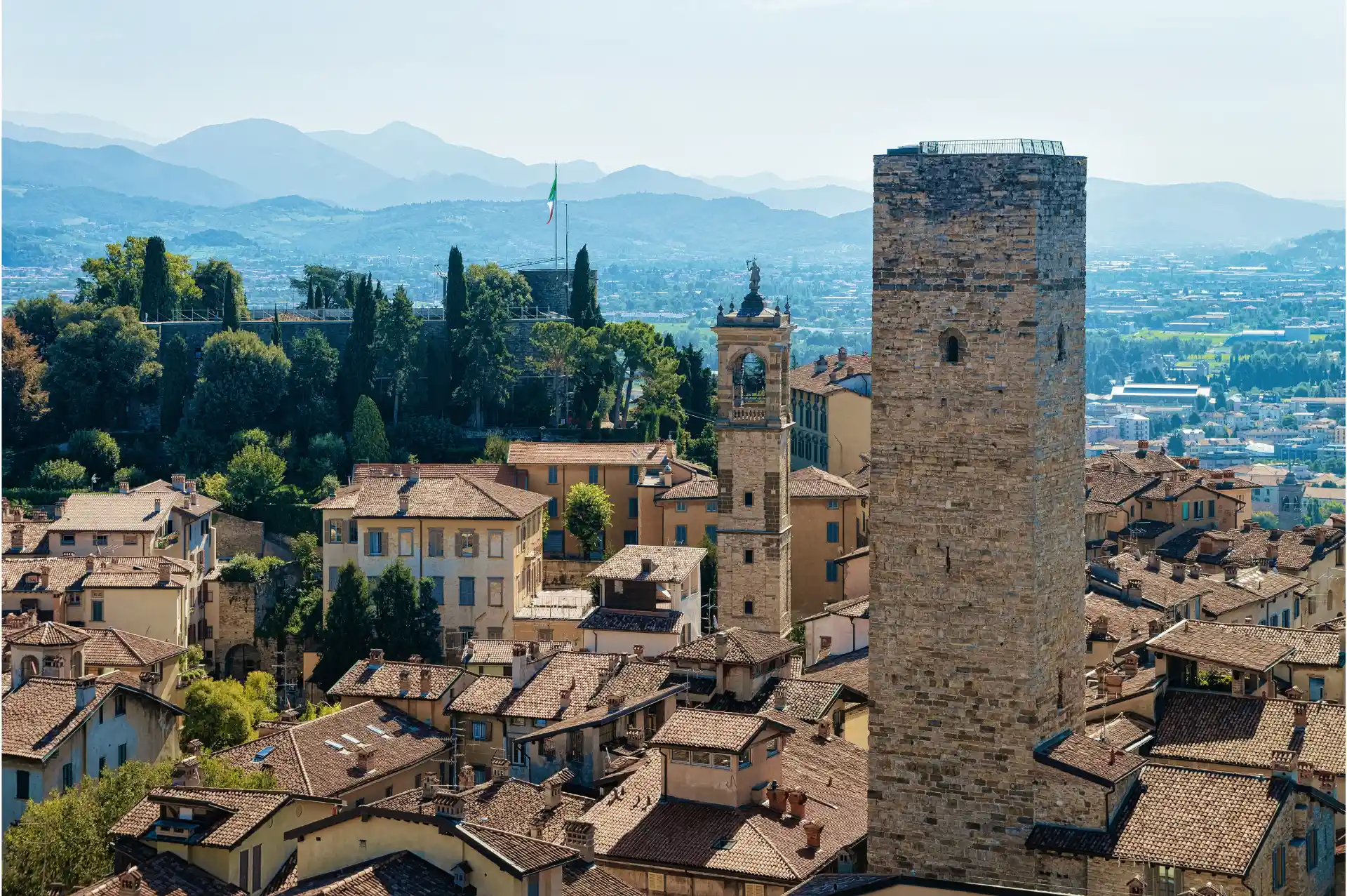
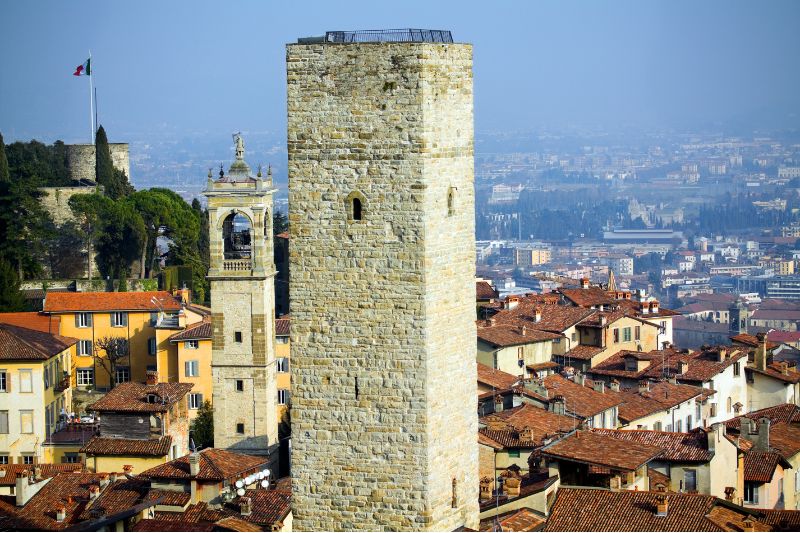
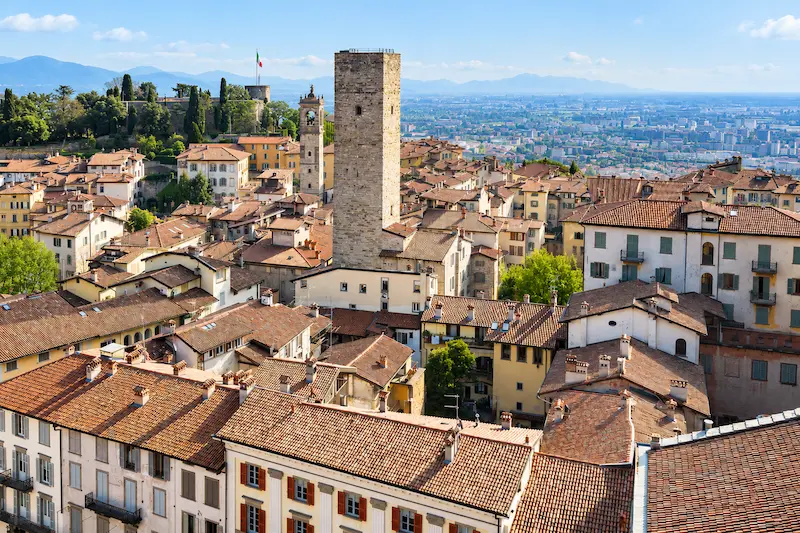
The Gombito Tower is one of the most recognisable symbols of Bergamo Alta, visible from much of the Upper Town with its stone silhouette rising above the rooftops of the historic centre. It stands exactly at the intersection of Via Gombito, Via San Lorenzo and Via Mario Lupo, at the point where the ancient Roman road axes once crossed.
For those arriving in Bergamo Alta on foot or by funicular, the Gombito Tower is often the first major medieval monument encountered along the way to Piazza Vecchia. Today, the main tourist information office in the Upper Town is located at its base.
All you have to do is look up along Via Gombito to see it rising above the rooftops, austere and square, just as it has for eight centuries.
The History of Gombito Tower
The name “Gombito” has a precise linguistic origin, linked to the tower’s location. The building stands at a compitum, the meeting point of the two main road axes of the Roman city, the cardo and the decumanus maximus, corresponding to today’s Via San Lorenzo and Via Mario Lupo on one side and Via Gombito on the other. According to historians, the tower’s name derives from the Latin term compitum, meaning crossroads.
The tower was built in the 12th century, when it belonged to the Del Zoppo family, one of the noble families in Bergamo which, as in many other medieval communes of northern Italy, competed to build ever taller towers as symbols of political and military prestige. For centuries, Gombito Tower retained its original function of watchtower and defensive structure, a feature that is still evident today in its compact structure and limited number of openings.
From the 16th century onwards, the building’s role changed: shops were opened on the ground floor, and the tower retained this commercial function until the final decades of the 20th century. A report by the Venetian captain Giovanni Da Lezze, dated 1596, already describes it as the “torre dell’hostaria del Gombedo”, confirming that this use had by then become well established.
In 1877, the owners donated the tower to the Municipality of Bergamo, which in 1892 installed the internal wooden staircase, much of which is still in use today. The most recent restoration works documented by the municipality date from 2001 to 2009 and involved structural consolidation, restoration of the external façades and safety improvements to the staircase.
Some aspects of the tower’s history remain less certain in the sources. This is the case, for example, with the exact reasons that led to the demolition of the upper section of the building in the 19th century.
How tall is Gombito Tower?
Official sources agree that the tower currently stands at an approximate height of 52 metres (51.60 metres according to the technical information provided by the Municipality of Bergamo), compared with the 64 metres of the original tower.
During the 19th century, the upper section was demolished, according to local tradition for safety reasons related to the stability of the masonry, although the available documentation does not allow every detail of the intervention to be reconstructed with absolute certainty.
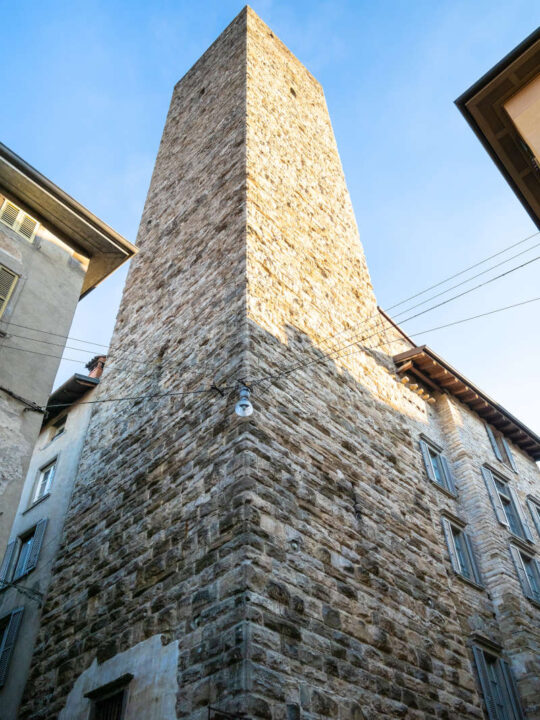
What is documented precisely, however, is the construction technique: the tower is built from 6,827 squared blocks of grey sandstone from Sarnico, arranged in regular horizontal courses. This workmanship is considered among the finest found in Bergamo’s medieval towers.
Despite the reduction in height carried out in the 19th century, Gombito Tower remains one of the tallest surviving historic towers in Bergamo Alta. Among those whose height is known with certainty, only the Civic Tower in Piazza Vecchia is a few metres taller.
How to climb Gombito Tower
The climbing experience
Climbing Gombito Tower means tackling 263 steps along a narrow and steep internal staircase, consistent with the building’s original defensive purpose.
The staircase still in use today is largely the original wooden one installed by the Municipality of Bergamo in 1892. Four narrow windows, located at a height of around 42 metres and reached by stone steps, provided the tower’s interior with minimal light over the centuries.
The final section of the climb, built into the thickness of the masonry, has irregular steps with a considerable rise. This is the part where the Municipality of Bergamo recommends taking particular care to avoid slipping or hitting your head.
Every flight of stairs tells the story of centuries of steps worn down by generations of footsteps, first those of medieval guards and today those of visitors.
Opening hours, access, prices and booking
Access to Gombito Tower is subject to certain requirements established by the Municipality of Bergamo, designed to ensure safety on a narrow staircase with no lift.
The tower can only be climbed on foot, with comfortable shoes. Children aged three and over are allowed to enter provided they are accompanied by an adult who holds their hand.
Animals, large backpacks, suitcases or bulky objects that could obstruct the ascent or descent are not allowed. Capacity is limited to ten people at a time to prevent overcrowding on the intermediate landings and at the top terrace.
Before planning your visit, it is useful to know who is advised against climbing the tower, according to the official indications of the Municipality of Bergamo:
- people with heart conditions,
- people suffering from claustrophobia,
- pregnant women,
- people with mobility difficulties or breathing problems,
- anyone attempting the ascent or descent on rainy days, when the steps may become slippery.
As for opening hours, prices and booking arrangements, the situation at Gombito Tower is currently changing. Inside the building, directly above the tourist information office, the Municipality of Bergamo inaugurated a new UNESCO Visitor Centre in 2026, dedicated to the serial World Heritage site of the Venetian Works of Defence, of which the Venetian Walls of Bergamo are part. The exhibition route extends across the different floors of the tower, with multimedia installations and information about the history of the Venetian Walls.
During an initial experimental phase, admission was free for small groups without the need for a reservation. A second phase, planned to coincide with the reopening of the panoramic terrace at the top, will introduce mandatory booking and an admission ticket for access to the summit.
As opening hours, prices and booking arrangements may therefore change in the short term, it is always advisable to check the latest updates on the official channels of the Municipality of Bergamo before visiting.
The panoramic view
Those who manage to reach the top are rewarded with a 360-degree view over Bergamo Alta, the plain, the hills around Bergamo and, on the clearest days, as far as Milan and the Orobie Prealps.
It is one of the most central panoramic viewpoints in the whole of Bergamo Alta, precisely because the tower stands at the heart of the network of streets connecting Piazza Vecchia with the rest of the medieval town.
What to do around Gombito Tower
Thanks to its location at the meeting point of the main streets of Bergamo Alta, Gombito Tower is also an excellent starting point for exploring the heart of the medieval town on foot.
Via Gombito itself, which runs alongside the base of the tower, is one of the city’s most characteristic streets, with its shop windows, artisan workshops and shops selling local products set among the ancient stone walls.
From here, several of the most significant sights in Bergamo Alta can be reached within a few minutes on foot:
- Piazza Vecchia, less than a two-minute walk along Via Gombito, the civic heart of the city with the Palazzo della Ragione and the Civic Tower,
- Piazza Duomo, home to the Basilica of Santa Maria Maggiore, the Cathedral of Sant’Alessandro and the Colleoni Chapel,
- Via Colleoni, known as the “Corsarola”, the historic pedestrian street running lengthwise through the whole of Bergamo Alta,
- Via San Lorenzo, which descends towards one of the most evocative sections of the Venetian Walls,
- the historic Lavatoio on Via Mario Lupo, just a short distance from the tower.
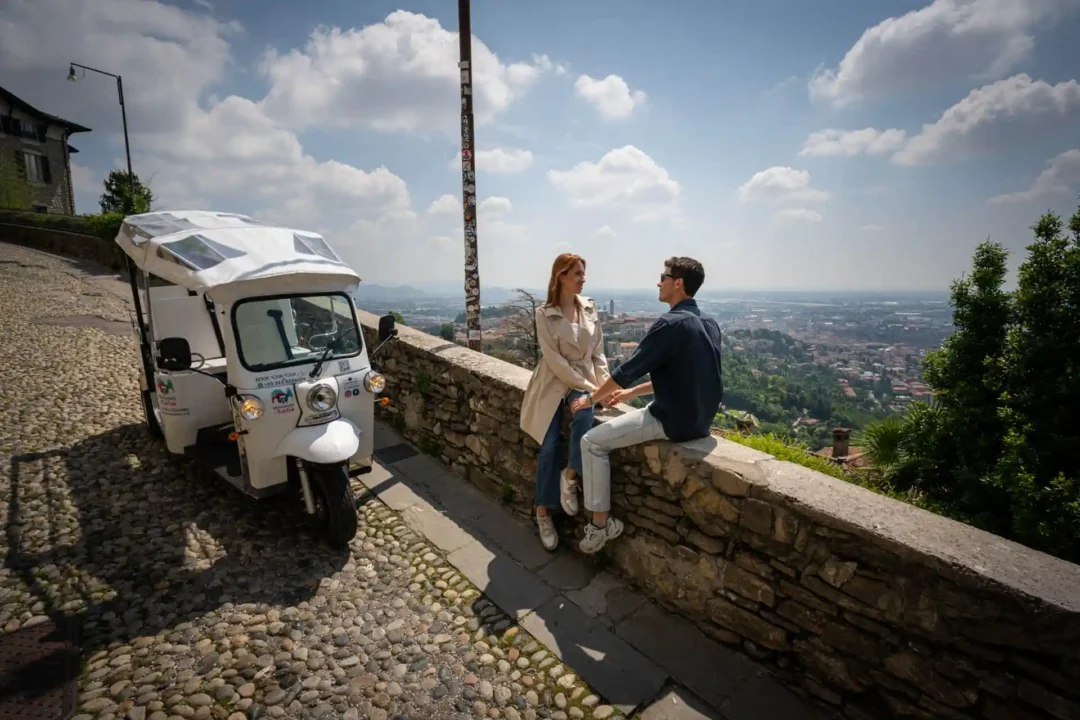
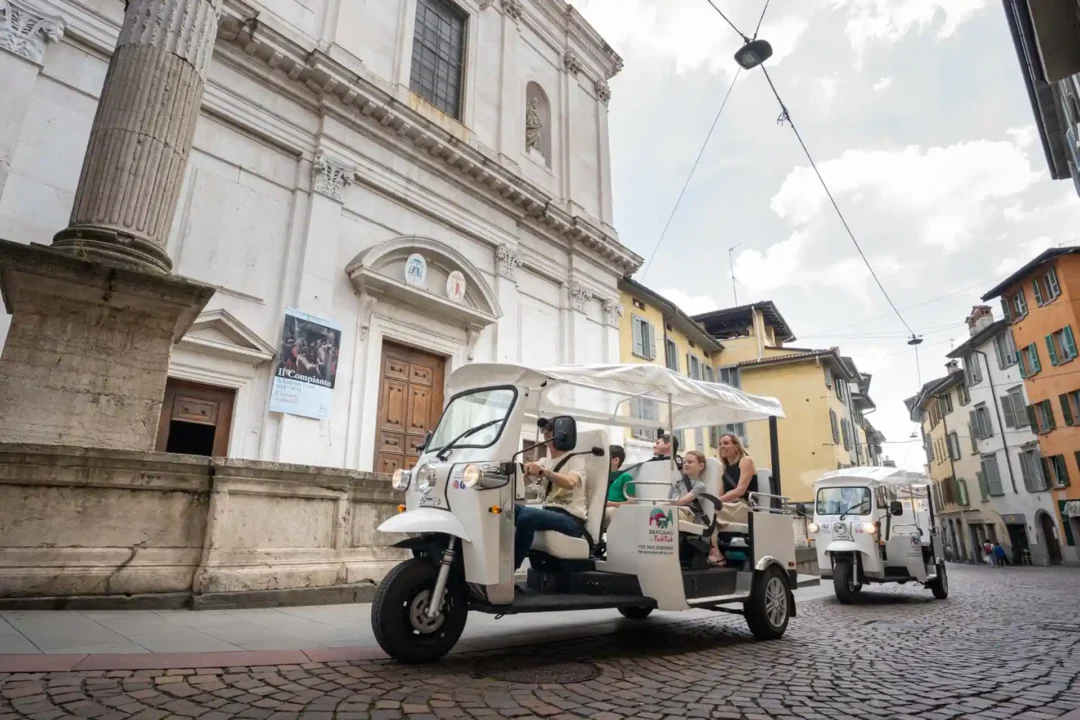
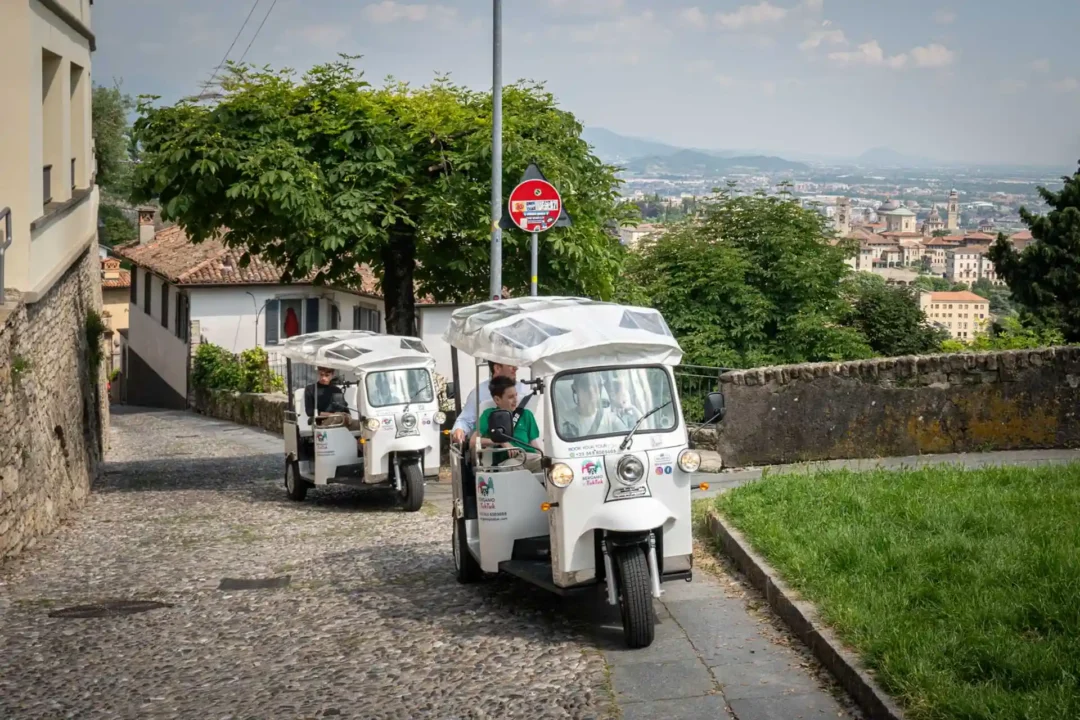
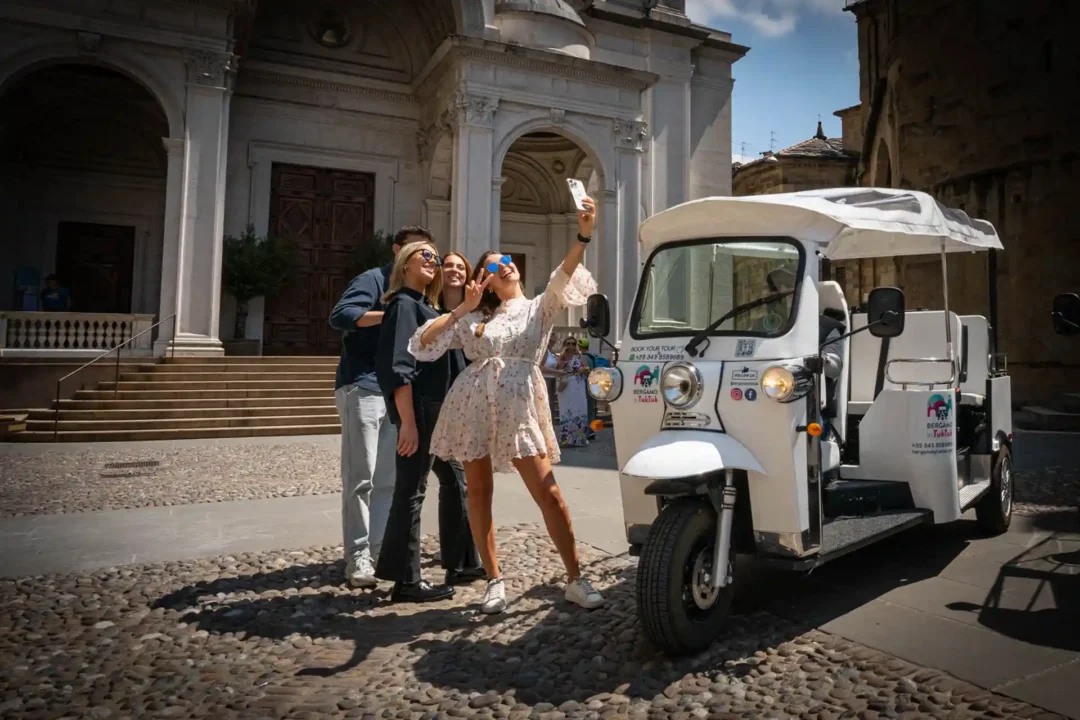
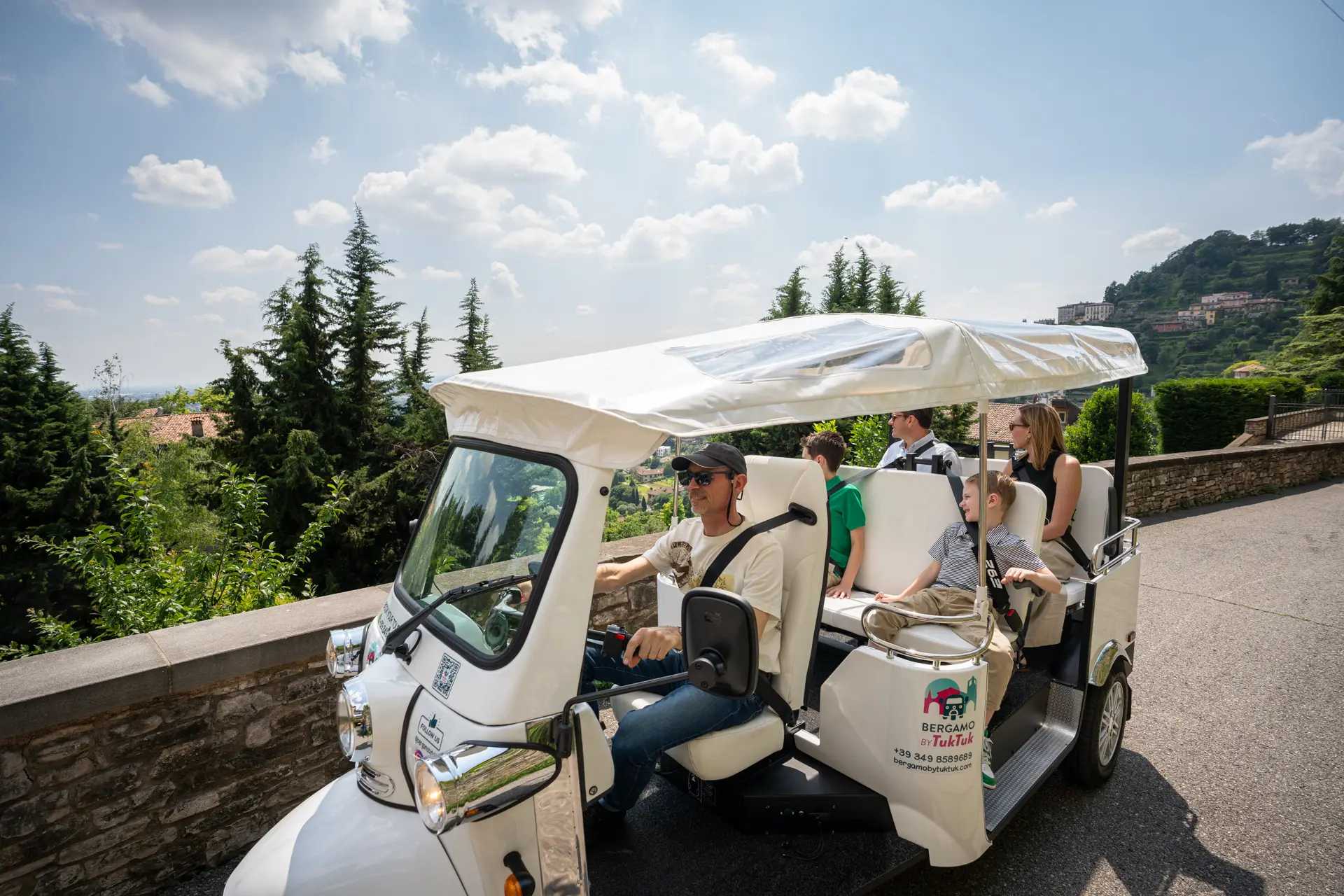
For those who would rather experience this route in a different way than simply walking, Bergamo By Tuk Tuk offers themed tours through this very area of Bergamo Alta, taking in narrow streets, historic gates and the UNESCO-listed Venetian Walls, with stops at some of the most scenic viewpoints around Gombito Tower. It is a comfortable and original way to find your bearings among the streets of the historic centre while hearing stories from people who know the city well.
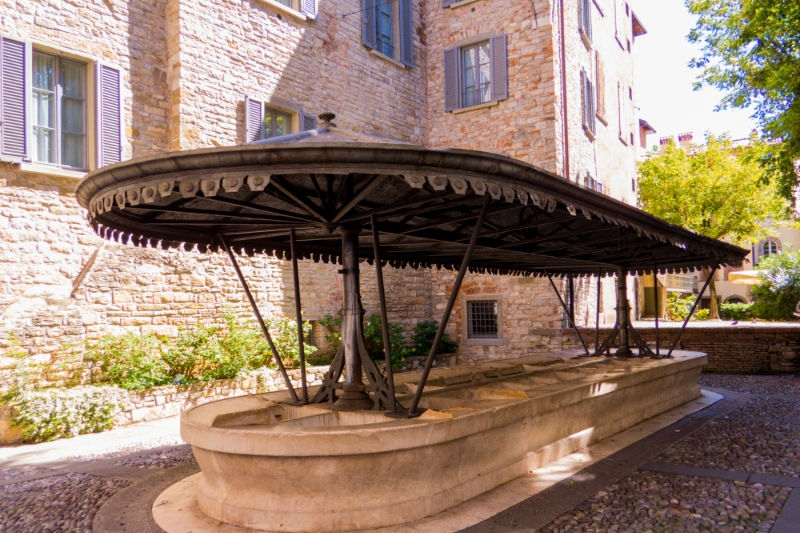
Historic Lavatoio on Via Mario Lupo
Other historic towers in Bergamo Alta
The Gombito Tower is not the only surviving testimony to the period when Bergamo’s noble families competed to build increasingly imposing towers. Bergamo Alta preserves other vertical structures which, although sharing the same medieval origins, differ in terms of history, function and height.
The Civic Tower, or Campanone
In Piazza Vecchia, just a few steps from Gombito Tower, stands the Civic Tower, known by the people of Bergamo as the Campanone. Built between the 11th and 12th centuries by the Suardi family, its 52.76-metre height makes it a few metres taller than Gombito Tower and it is now the tallest tower in Bergamo Alta.
Unlike Gombito Tower, the Campanone has a lift as well as a staircase with 230 steps. It is particularly famous for the one hundred chimes sounded by its largest bell every evening at 10 pm, recalling the ancient closing of the city gates during the Venetian period.
The Rocca and the Mastio
The Rocca of Bergamo Alta stands on Sant’Eufemia Hill, a fortification that was enlarged and modified several times over the centuries. The Mastio, the tallest tower in the complex, offers a different viewpoint from that of Gombito Tower, looking mainly towards the Brembana Valley and Lower Bergamo. It is an example of how each of the city’s towers responded to specific observation needs, linked to its position within the surrounding landscape.
Compared with these two structures, the Gombito Tower stands out for having largely retained its original medieval character and layout. Although it has undergone interventions over time, such as the 19th-century reduction in height and the rebuilding of the internal staircase, it has not undergone the more conspicuous transformations seen in other city towers, such as the addition of bells or lifts.
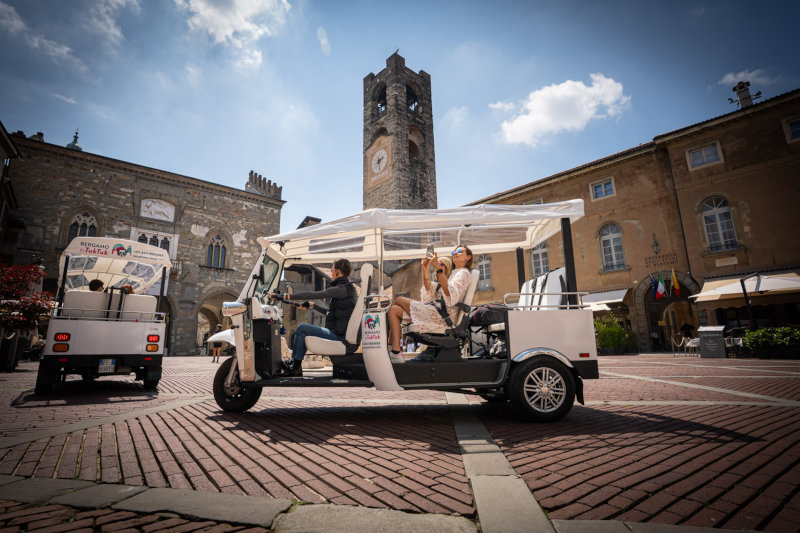
Tuk Tuk in Piazza Vecchia
Why visit Gombito Tower?
Gombito Tower brings together several reasons to visit in a single place: it is a well-preserved example of medieval defensive architecture, occupies a symbolic position at the point where the city’s ancient Roman roads once crossed, and its history spans eight centuries of change, from its military and commercial functions to its current role as a cultural landmark with the new UNESCO Visitor Centre.
Climbing its 263 steps is also a physical experience, almost a small rite of passage between present-day Bergamo and its medieval past.
Those who reach the top, slightly out of breath and with the steps still beneath their feet, suddenly find themselves at the very heart of Bergamo Alta, with terracotta rooftops stretching out in every direction.
FAQ
What is the tallest building in Bergamo?
Among the historic monuments of Bergamo Alta, the tallest building is the Civic Tower in Piazza Vecchia, the Campanone, which reaches 52.76 metres, a few metres more than Gombito Tower. This figure refers to the historic towers of the medieval centre, not to the entire municipal territory of Bergamo.
What is the highest point in Bergamo Alta?
The highest point of the historic core of Bergamo Alta, enclosed by the Venetian Walls, is located in the Colle Aperto area, at around 370 metres above sea level. Just beyond the walls, on San Vigilio Hill, which can be reached on foot or by funicular, the elevation rises further, exceeding 490 metres.
How high are the walls of Bergamo?
The Venetian Walls surrounding Bergamo Alta, a UNESCO World Heritage Site since 2017, extend for approximately 5.3 kilometres and range in height from 10.5 metres at their lowest point near Porta San Lorenzo to almost 22 metres at their highest point, at the San Vigilio bastion.
Bergamo is a city that surprises at every turn
- The Colleoni Chapel in Bergamo
- The Accademia Carrara in Bergamo: Art and Culture for over 200 Years
- Lazzaretto of Bergamo: Life Beyond Life for 600 Years
- GAMeC, Bergamo’s Leading Centre for Modern and Contemporary Art
- Bernareggi Museum in Bergamo: Everything You Need to Know Before Your Visit
- What to See in Bergamo Alta: Must-See Places, Hidden Corners and Local Atmosphere
Itineraries, experiences and a local soul: this is the Bergamo that we want to tell you about!