
19 January 2024
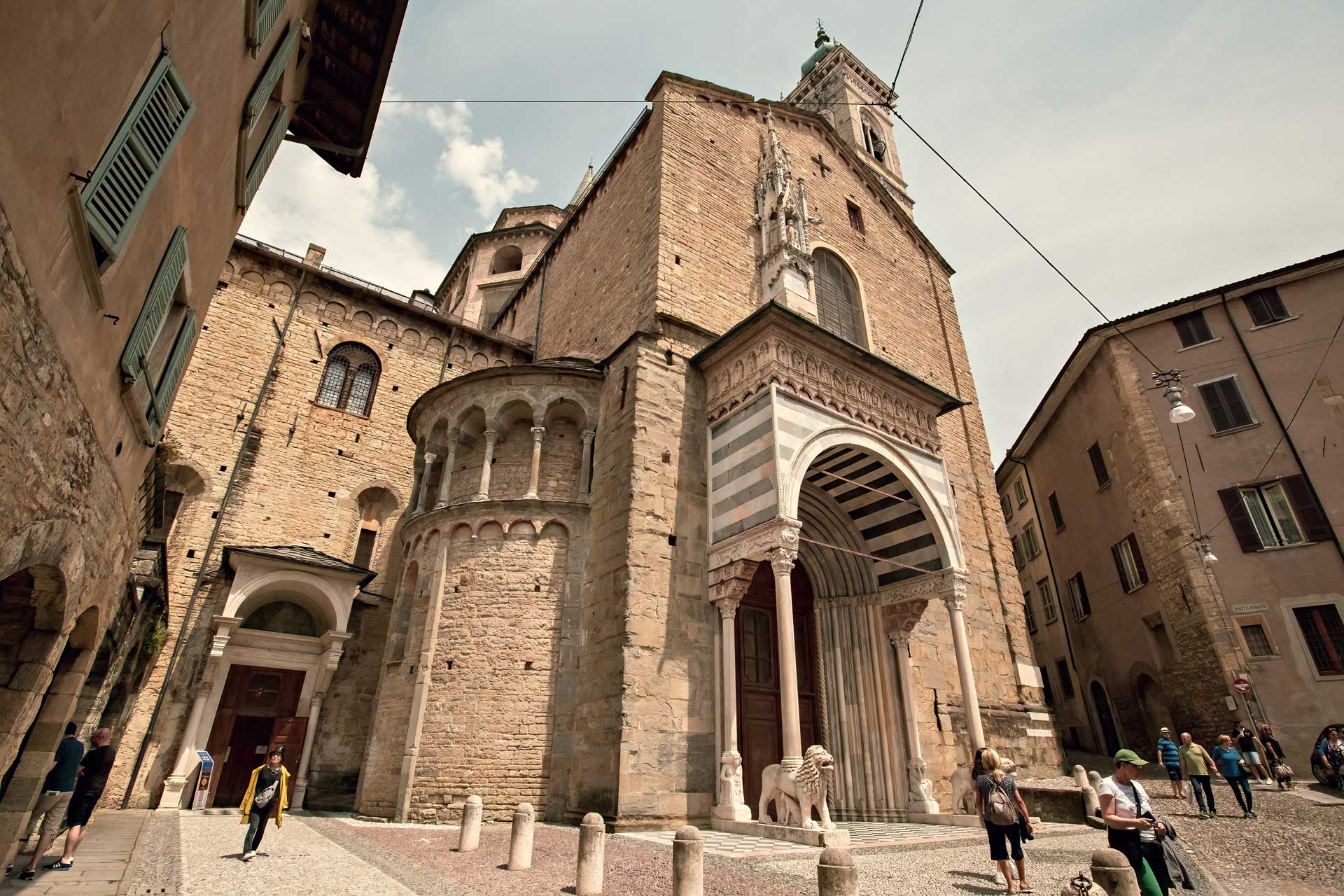
In the beating heart of Bergamo Alta, nestled between Piazza Vecchia and Piazza Rosate, stands the Basilica of Santa Maria Maggiore: one of the most significant religious monuments in all of Lombardy.
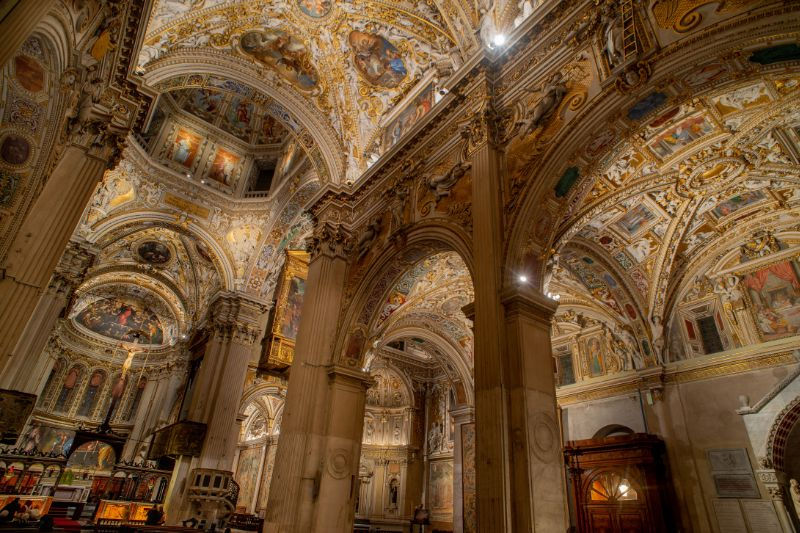
For the people of Bergamo, it is not just a church, but a symbol of identity — a place where history, faith, and art blend in an extraordinary way. First-time visitors are struck by the evident contrast between the sober Romanesque/Gothic exterior and the Baroque decorative explosion revealed as soon as they step inside.
Visiting this basilica means embarking on a journey through almost nine hundred years of history, art, and popular devotion. It is no exaggeration to call it a treasure chest: it houses Flemish and Florentine tapestries, 14th-century frescoes, the celebrated inlaid wooden choir based on designs by Lorenzo Lotto, and the tombs of figures who shaped the cultural history of Bergamo and Italy as a whole.
It is, in every respect, one of the most important and beloved churches in Bergamo Alta.
History of the Basilica of Santa Maria Maggiore: from its origins to the Baroque era
The history of the Basilica of Santa Maria Maggiore in Bergamo has its roots in a moment of great collective drama. In 1133, a severe drought struck the Bergamo area, followed by famine and plague.
The population prayed to the Virgin Mary for protection and, when the calamity began to subside, the citizens of Bergamo fulfilled their vow: on August 15, 1137, the Bishop of Bergamo, Gregorio, blessed the foundation stone of the new church.
The construction was entrusted to Master Fredo, identified as one of the Comacine masters, and was built on the site of a pre-existing 8th-century church dedicated to the Virgin, itself erected on an area already considered sacred in Roman times.
Work continued for centuries, influenced by fluctuating financial resources. In the 14th century, Giovanni da Campione gave the basilica its most refined Gothic appearance, with the famous polychrome marble portals.
In 1449, management was entrusted to the Consorzio della Misericordia Maggiore (today Fondazione MIA), which in the following centuries became the driving force behind its artistic transformations.
Key moments in the building’s history include:
- 1137 – Foundation stone laid by Bishop Gregorio, based on a design by Master Fredo.
- 1351–1367 – Giovanni da Campione creates the Gothic portals in polychrome marble with porches supported by lions.
- 1472 – Bartolomeo Colleoni orders the demolition of an apse then used as a sacristy to create space for his funerary chapel.
- 1522–1555 – Giovan Francesco Capoferri carves the wooden choir based on cartoons by Lorenzo Lotto.
- Late 17th century – Giovanni Angelo Sala and his son Gerolamo create the imposing Baroque stucco decorations that still characterize the interior today.
Where it is located and what it looks like: exterior and interior of the Bergamo basilica
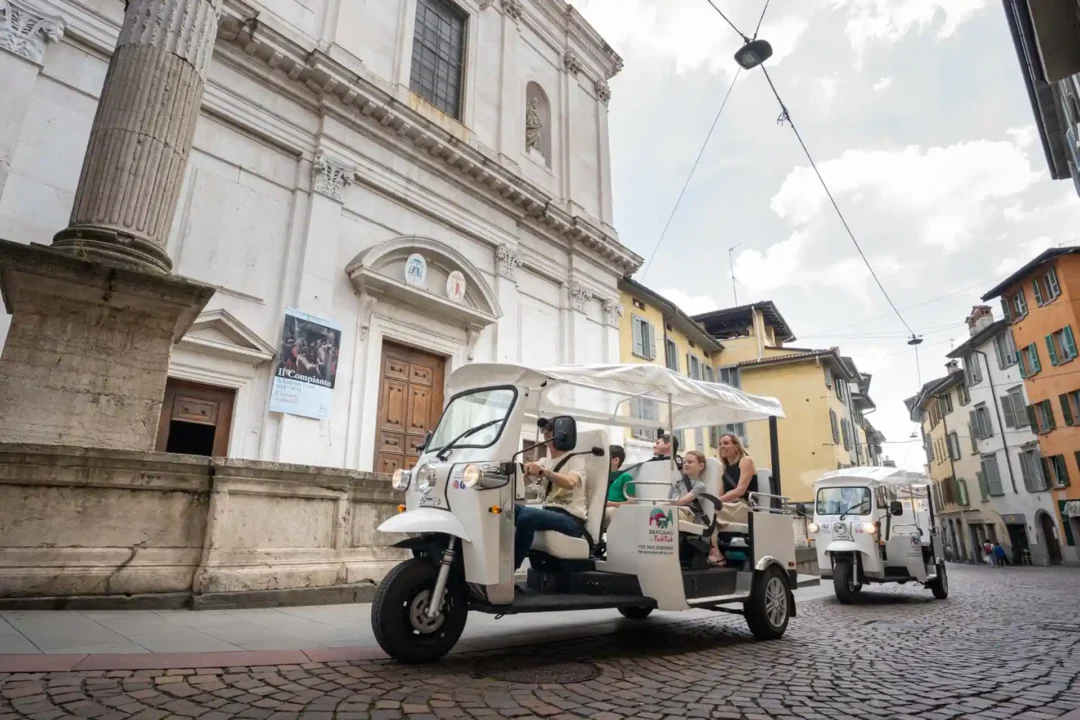
The basilica is located in Piazza Duomo in Bergamo Alta, easily reachable by funicular from the lower town, with our Tuk Tuks, or by walking through the medieval historic center. It stands next to the Cathedral of Sant’Alessandro and adjacent to the spectacular Colleoni Chapel, with which it shares the same architectural complex.
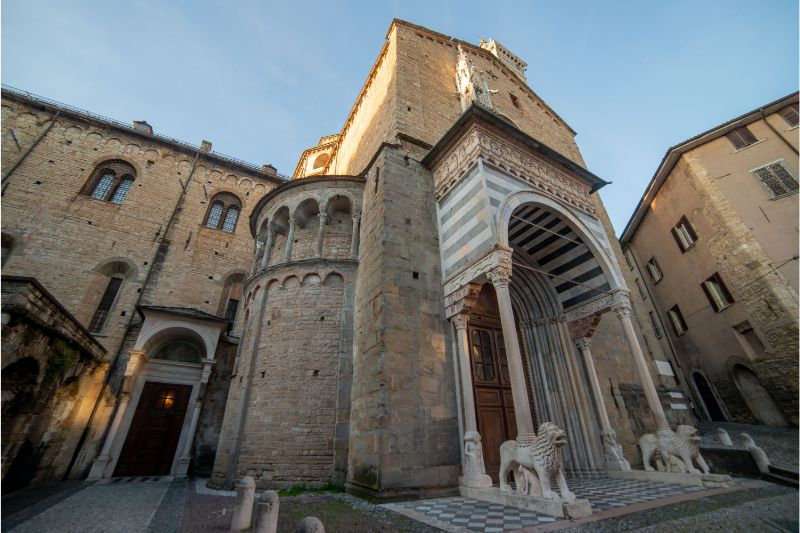
One of the first things that surprises visitors approaching the basilica is the absence of a traditional façade with a central entrance. The building, laid out in a rectangular plan with three naves, is accessible through four side portals, two on the north side (facing Piazza Duomo) and two on the south side (facing Piazza Rosate).
The main portals are topped by 14th-century porches supported by marble lions: red Verona marble on the north side and white Candoglia marble — the same used for Milan Cathedral — on the south side. The color of the external sandstone ranges from amber yellow to stony gray, giving the structure an austere yet warm appearance.
The interior offers a completely different experience. The original Romanesque structure — with cross vaults and pillars — is almost entirely concealed by the rich 17th-century Baroque decoration, full of gilded stuccoes, paintings, and frescoes. Along the walls and pillars hang twenty-five tapestries, partly made in Florence between 1583 and 1586 based on designs by Alessandro Allori, and partly of Flemish manufacture, depicting episodes from the Life of Mary.
The wooden choir in the presbytery, inlaid by Capoferri based on designs by Lorenzo Lotto between 1522 and 1555, is considered one of the absolute masterpieces of the Lombard Renaissance. Lotto’s work stands out for its vibrant colors achieved through the skillful use of different wood types.
Also not to be missed is the Baroque wooden confessional carved by Andrea Fantoni in 1704, a true jewel of Lombard woodcarving, and the octagonal dome rising above the crossing of the nave and transept, recognizable from the outside by its slender silhouette.
Who is buried in the Basilica of Santa Maria Maggiore?
The basilica has always had a strong funerary vocation and houses the remains of three historically significant figures, all authentically connected to the city of Bergamo.
The most famous monument is dedicated to Gaetano Donizetti (1797–1848), the great Bergamo-born composer of operas such as Lucia di Lammermoor and L’elisir d’amore. The funerary monument, created between 1852 and 1855 by Swiss-Italian sculptor Vincenzo Vela, was commissioned by the musician’s brothers. In white and gray marble, it features at the top a weeping female figure representing Harmony, and below seven musical putti — one for each note — mourning the loss of the Maestro. Donizetti’s remains were definitively transferred here in 1875, with his skull — after a singular and troubled story — reunited with the rest of the body only in 1951.
Next to Donizetti’s monument is the tomb of his teacher, Johann Simon Mayr (1763–1845), then chapel master, a Bavarian composer naturalized in Bergamo. In 1805, he founded free music schools for poor children that operated within this very basilica — the same school where Donizetti took his first steps, receiving lessons in singing and harpsichord. His monument dates to 1852.
To the left of the entrance stands the monumental tomb of Cardinal Guglielmo Longhi (or Longo degli Alessandrini), created by Ugo da Campione between 1319 and 1320. It is one of the most important examples of Gothic sculpture in Lombardy.
How much does it cost to visit the Basilica of Santa Maria Maggiore: tickets and information
Visiting the Basilica of Santa Maria Maggiore in Bergamo requires an entrance ticket for non-resident visitors.
According to the latest information available on the official Visit Bergamo website, the pricing structure is as follows:
- €5 – Full ticket for non-residents of the Municipality and Province of Bergamo.
- €2 – Reduced ticket for young people aged 14 to 25 and for visitors over 70.
- Free – For residents of the Municipality and Province of Bergamo, children up to 13 years old, people with disabilities and one companion, school groups up to secondary level, priests, nuns, journalists, and law enforcement officers. Admission is always free during religious services.
Volunteers from the Italian Touring Club welcome visitors and guide them through the Museum of the Treasure and Lorenzo Lotto’s Wood Inlays: this service is available from Thursday to Sunday, from 2:30 pm to 5:30 pm.
For any need, you can contact the sacristy at +39 035/22.33.27 or directly reach out to Fondazione MIA (tel. +39 035/211355 – email: info@fondazionemia.it
), which manages the basilica.
It is advisable to check for any pricing updates directly on the official website fondazionemia.it.
Opening hours and Mass times of the Basilica of Santa Maria Maggiore
The basilica is open to the public all year round, with hours that vary slightly depending on the season.
During the winter period (November 1 to March 31), opening hours are:
- Monday to Friday from 9:00 am to 12:30 pm and from 2:30 pm to 5:00 pm,
- Saturday from 9:00 am to 12:30 pm and from 2:30 pm to 6:00 pm,
- Sunday and public holidays from 9:00 am to 12:45 pm and from 3:00 pm to 6:00 pm.
During the summer period (April 1 to October 31), the basilica is open daily from 9:00 am to 12:30 pm and from 2:30 pm to 6:00 pm.
Mass times are as follows:
- Weekdays: Holy Mass at 10:00 am.
- Sundays and public holidays: Holy Masses at 11:00 am and 12:15 pm (It is advisable to check for any changes directly on the official website of the Fondazione MIA or on site). The 11:00 am Sunday Mass is the solemn celebration with the participation of the Basilica’s Musical Chapel, one of the most prestigious musical institutions in Italian history.
Please note that tourist visits are suspended during religious services and admission is free for those attending the celebrations. Opening hours may vary on holidays or during special events: always check the official website fondazionemia.it before your visit.
Basilica Of Santa Maria Maggiore in Tuk Tuk
What to visit near the Basilica of Santa Maria Maggiore?
The basilica’s location in the heart of Bergamo Alta makes it the ideal starting point for discovering the other attractions of Città Alta. Within just a few steps, you will find some of the most significant wonders of the entire city.
- Colleoni Chapel – Immediately adjacent to the basilica, this Renaissance funerary chapel was commissioned by Bartolomeo Colleoni in the 15th century. It is considered one of the absolute masterpieces of the Lombard Renaissance, with its polychrome façade inlaid by Giovanni Antonio Amadeo.
- Piazza Vecchia – Just a few meters from the basilica, this square is considered by many to be one of the most beautiful in Italy. Le Corbusier called it “the perfect square.” It is overlooked by the Palazzo della Ragione and the Civic Tower (the Campanone).
- Cathedral of Sant’Alessandro – The city’s main Catholic church, dedicated to Bergamo’s patron saint, stands directly on Piazza Duomo next to the basilica.
- Diocesan Museum “Il Bernareggi” – Recently reopened and located to the right of the Colleoni Chapel, it offers four points of interest: the Bishop’s Palace and Aula Picta, the Early Christian Cathedral, the Oratory of San Lupo, and the Baptistery, located in the same square — a small medieval octagonal building and precious testimony of Bergamo’s Romanesque architecture.
- The Venetian Walls – The defensive walls surrounding Bergamo Alta have been a UNESCO World Heritage Site since 2017 (together with other Venetian fortresses). A walk along the bastions offers extraordinary panoramic views over the lower town and the Bergamo Prealps.
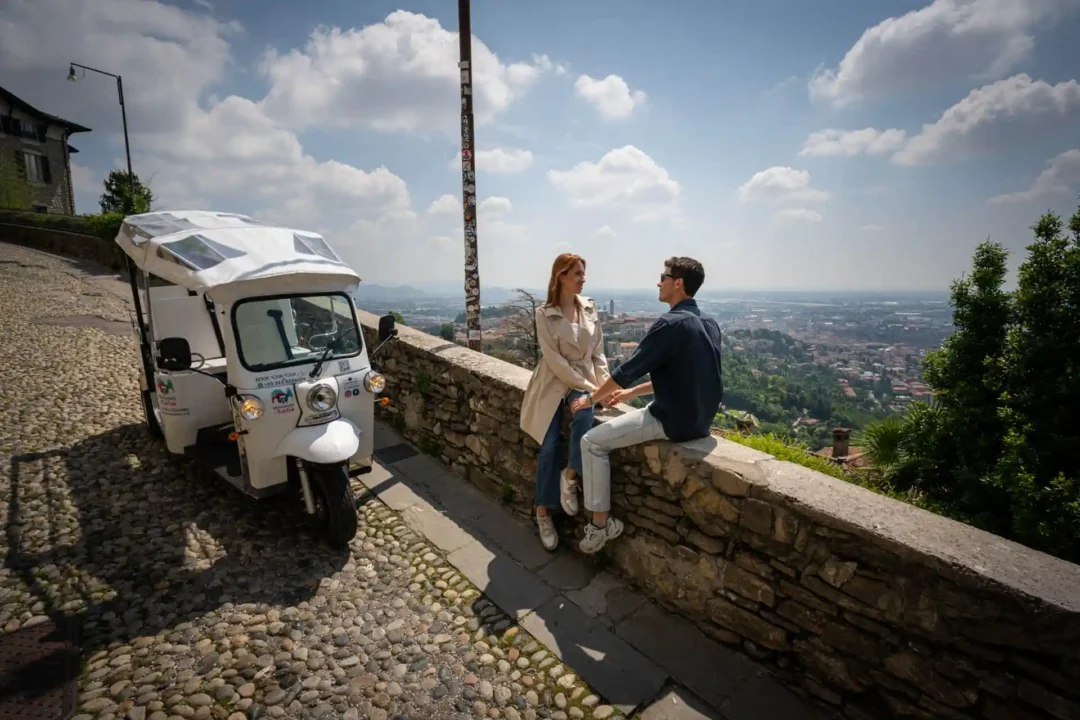
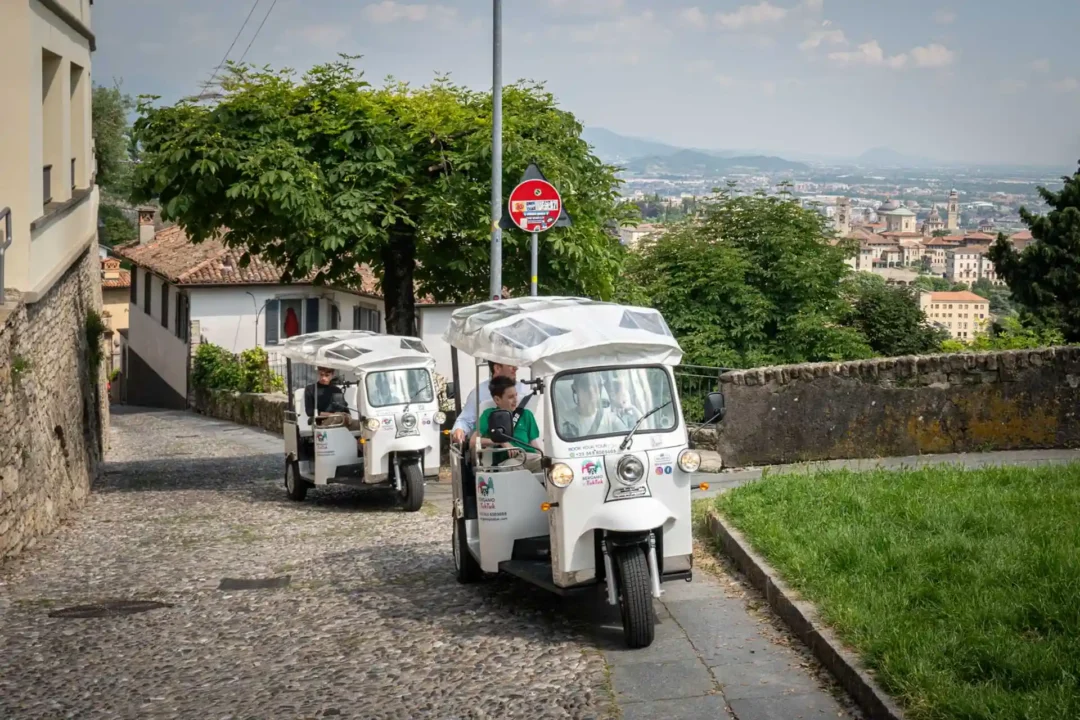
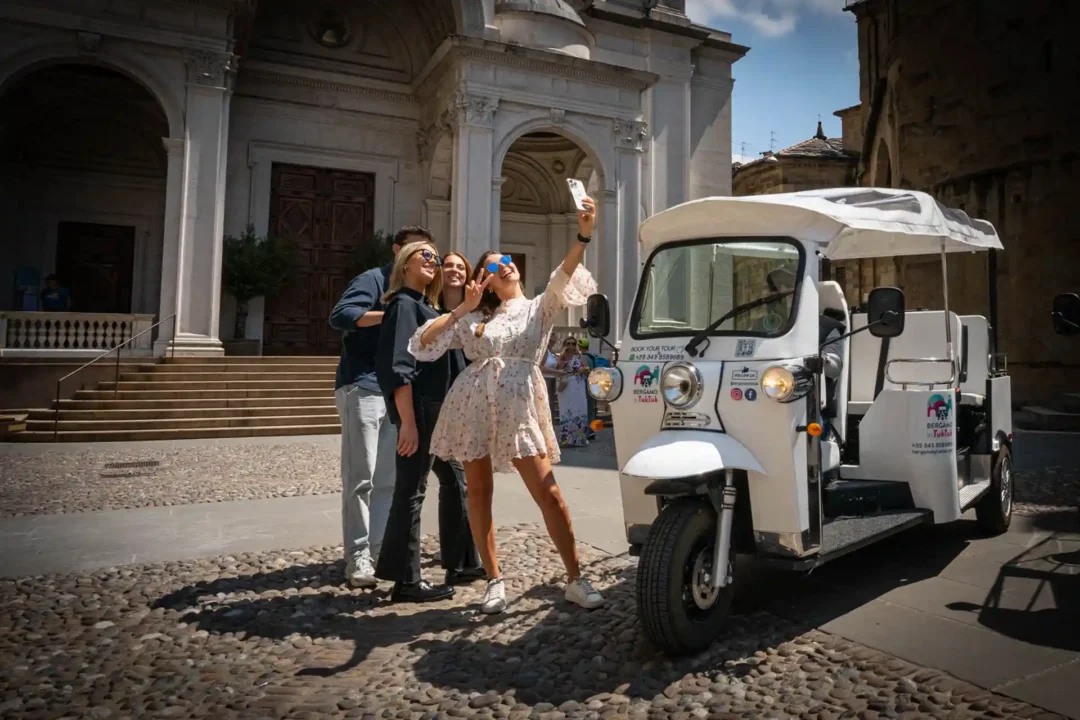
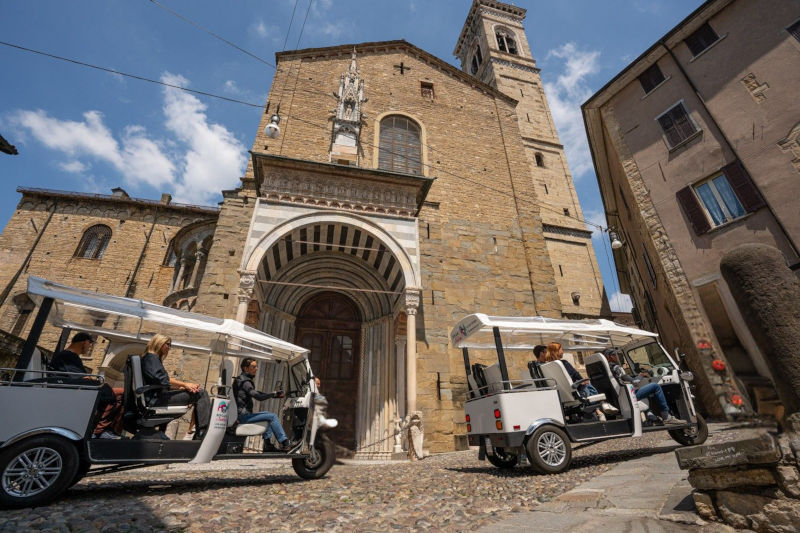
Bergamo Alta is best explored on foot, but if you would like to experience the city in an original way and enjoy every corner effortlessly, you can discover all these attractions with a Tuk Tuk tour: a comfortable, fun, and unusual way to appreciate the beauty of Bergamo Alta accompanied by an expert guide.
Itineraries, experiences and a local soul: this is the Bergamo that we want to tell you about!